
Can Online Casino Gaming Be Made More Accessible?
Published on November 14, 2025, 4:57 pm
by Jeff Grant 
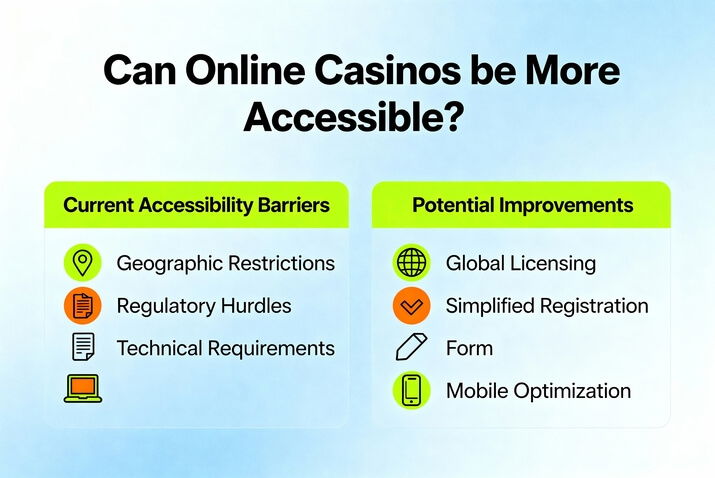
Online gambling has turned into a mainstream hobby these days, but despite this, many players are still left out when games are built for a smaller audience. More than a billion people have some form of disability, and tiny buttons or interfaces that depend on perfect eyesight and nimble fingers can make a session frustrating. Inclusive design is seen by some as a legal checkbox, but it isn’t. It gives players control. Adjustable fonts, high-contrast color schemes, and voice controls let you tailor the interface to your needs. Accessibility improves the experience for everyone.
Slowly, though, a growing recognition of accessibility is reshaping the industry. Major operators are beginning to talk openly about universal design, and smaller platforms are testing new layouts that prioritize clarity over clutter. It’s a slow change, and it's happening in small, meaningful ways. From simpler signup screens to better color contrast on slot interfaces.
Breaking Down The Barriers
Payments are often the first hurdle. Fortunately, many players find that using an online casino cash app payout, a service they already trust, removes the need to type long card numbers or navigate clunky forms, which is a relief when you’re using voice recognition or switch controls. Screen readers convert on-screen text into speech or braille, voice commands and haptic feedback offer better control, and closed captions help players follow live streams or dealer chat more easily.
Developers are also focusing on adaptive hardware. Now, games support controllers with programmable buttons or touch-free sensors. Even small changes, like larger hit boxes, and easier navigation, make a difference for players with limited mobility. This is even why researchers are experimenting with gesture-based inputs, where arm movements can spin a wheel or place a bet.
Another quite subtle change is in the sound design department, where some platforms now balance ambient sounds and announcer voices automatically so that players with mild hearing loss can still catch prompts or results and, more importantly, feel part of the game. That kind of detail is what makes digital gambling rooms feel more welcoming and less fatiguing for long sessions. Accessibility can be quiet, but it doesn’t always mean a huge feature rollout, just empathy built into the code.
Designing For Difference
Building for difference from the start is beneficial to everyone because even simple features like being able to zoom in on a payable or navigate without a mouse can be lifesavers on a small screen. These days, mobile-friendly gambling has become the standard, hence why casinos aggressively optimize for smartphones and tablets, and applying accessibility principles ensures those experiences work for all players.
By following the Web Content Accessibility Guidelines, which emphasize that content must be perceivable, operable, understandable, and robust, operators avoid costly retrofits and create platforms that perform consistently across devices.
Policy, Community, And Progress
You’ll find that regulators in many jurisdictions now have accessible design as part of licensing standards. Payment providers are beefing up anti-fraud systems while also supporting frictionless transactions. Developers who collaborate with advocacy groups tend to create features that address real needs instead of assumptions. A robust policy is particularly important for preventing security breaches, as we’ve seen before
Accessibility is an ongoing conversation, not just compliance, hence why community feedback, iterative updates, and shared knowledge push the industry closer to “true inclusion.” An inclusive approach makes business sense because accessible platforms attract loyal audiences and make gaming more fun for everyone.





COMMENTS:
By loading and joining the Disqus comments service below, you agree to their privacy policy.